A committee, but no process
A cell is constituted and a coordinator named, then nothing moves because no one has defined how an idea becomes a filing, or who decides.

An IP cell is judged by what comes out of it: filings, grants, transfers and trained faculty. We have established 70+ across India — policy, workflow, training and the filings themselves, not a nameplate on a door.
Tell us what you have built. We will tell you honestly what it needs — and what it costs.
A cell is constituted and a coordinator named, then nothing moves because no one has defined how an idea becomes a filing, or who decides.
Without a written policy covering student work, faculty output, funded research and consultancy, every promising disclosure stalls on the question of who owns it.
Teaching staff are asked to identify patentable work without ever having been shown what patentable means in practice.
Applications are filed for the accreditation count, then lapse because examination reports go unanswered.
Even granted IP sits idle because no one owns the commercialisation step.
Ownership, revenue sharing, student and faculty rights, funded and sponsored research, consultancy output — written to fit your statutes, not a template.
Roles, the disclosure form, the evaluation route, decision authority and timelines, so an idea has a defined path from disclosure to filing.
Sessions that teach staff to recognise protectable work in their own field, including patentability basics and prior art searching.
Seminars and workshops that build a pipeline of disclosures instead of waiting for them to appear.
Drafting, filing and prosecution through to grant — including replies to examination reports, which is where most institutional filings fail.
Records and reporting formats aligned to NAAC, NIRF and NBA innovation indicators.
Listing, valuation, licensing and transfer of institutional IP, with legal and payment infrastructure in place.
A yearly check on filings, grants, lapses and pipeline, with a plan for the year ahead.
We meet your leadership and R&D heads, review existing research output, and understand what your accreditation cycle needs.
We draft the IP policy and the cell's operating workflow, then take them through your approval process.
The cell is formally launched, with faculty training and a student awareness seminar delivered on campus.
We run a disclosure drive, assess what came in, and file the work that qualifies.
Examination reports are answered on time so applications proceed to grant rather than lapsing.
Granted IP is listed for licensing where appropriate, and the cell's output is reviewed annually.
Real work from our filings across manufacturing, education, pharma and consumer products. Client names appear only where we have permission to use them.
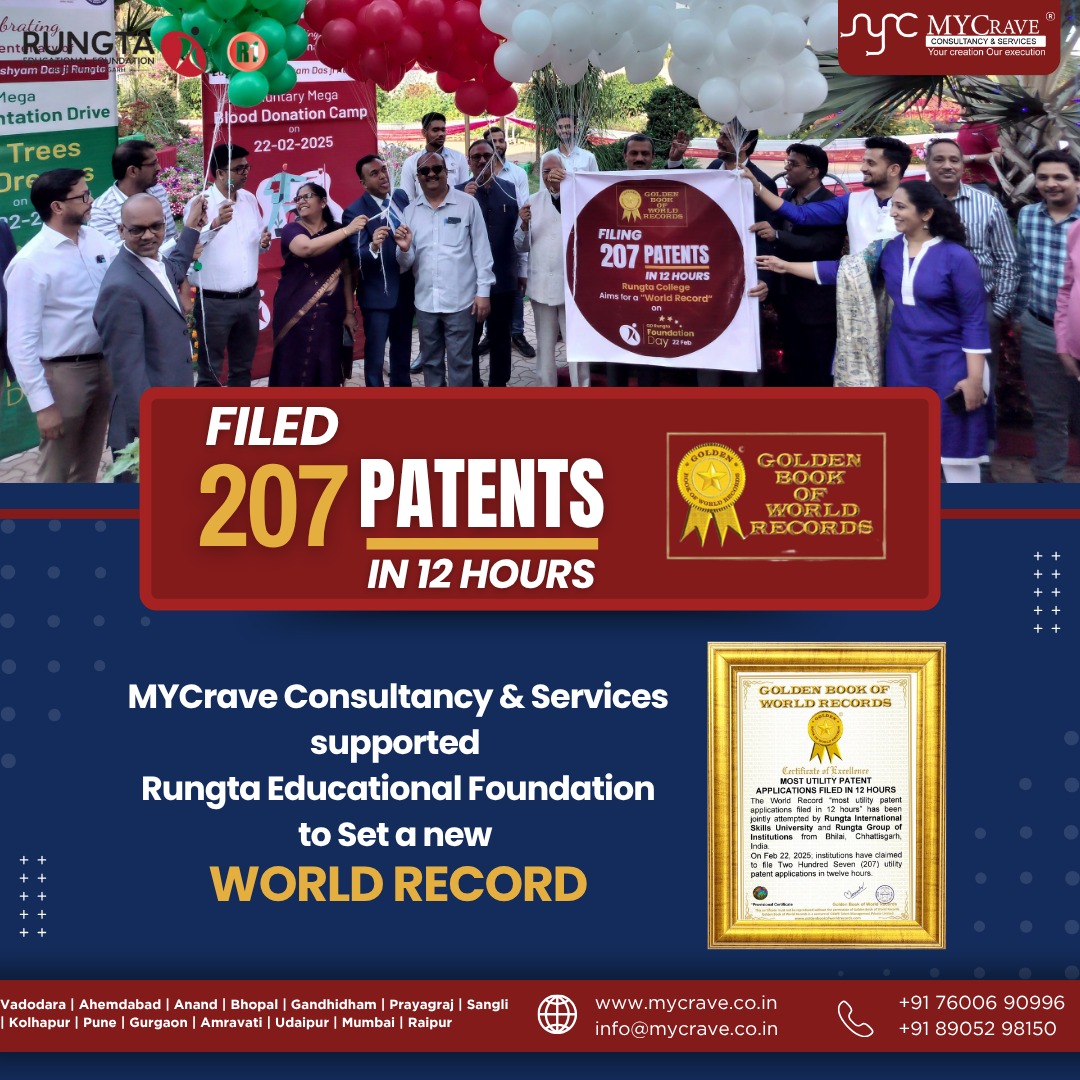
Rungta Education Foundation, Bhilai, Chhattisgarh
207 patents in 12 hours
MYCrave supported Rungta Education Foundation to file 207 utility patent applications in a single 12-hour window — a Golden Book of World Records achievement built on a year of preparing 5,000+ students and 250+ faculty.
Mr Satyam Mishra, Sigma University
Rs. 42 lakh copyright deal
An Android application in the customer feedback space was transferred to a private enterprise in a copyright deal valued at Rs. 42 lakh.
Mr Mithilesh Patel
106 designs released free of cost
An IP BANK India client made 106 industrial design patents available for public use, free of cost.
The policy and structure are usually in place within a few weeks of the discovery visit. The first filing cycle depends on your disclosure drive — most institutions see their first filings within a term.
It depends on the size of the institution, how many departments are involved and whether filings are included. We give a written proposal after the discovery visit, with the filing fees itemised separately from the setup work.
No. Several of the 70+ cells we have established began with no filings at all. The awareness programme is what generates the first disclosures.
Whatever your policy says — which is exactly why we draft it first. Most institutions choose a shared model between the institution and the inventor, with defined revenue sharing.
Yes. Filed and granted IP, technology transfers and awareness programmes all feed into innovation and research indicators. We supply the documentation in the format your team needs.
Yes, and often that is the better route. We audit what exists, find where the process breaks, and fix that rather than rebuilding.
Not happy with something? We keep a dedicated complaint-handling team, separate from the people delivering your matter. Every complaint gets a reference number and an independent review. Raise a complaint or send feedback.
A short conversation is usually enough to tell you whether you have something protectable, which route fits, and what it will cost.