
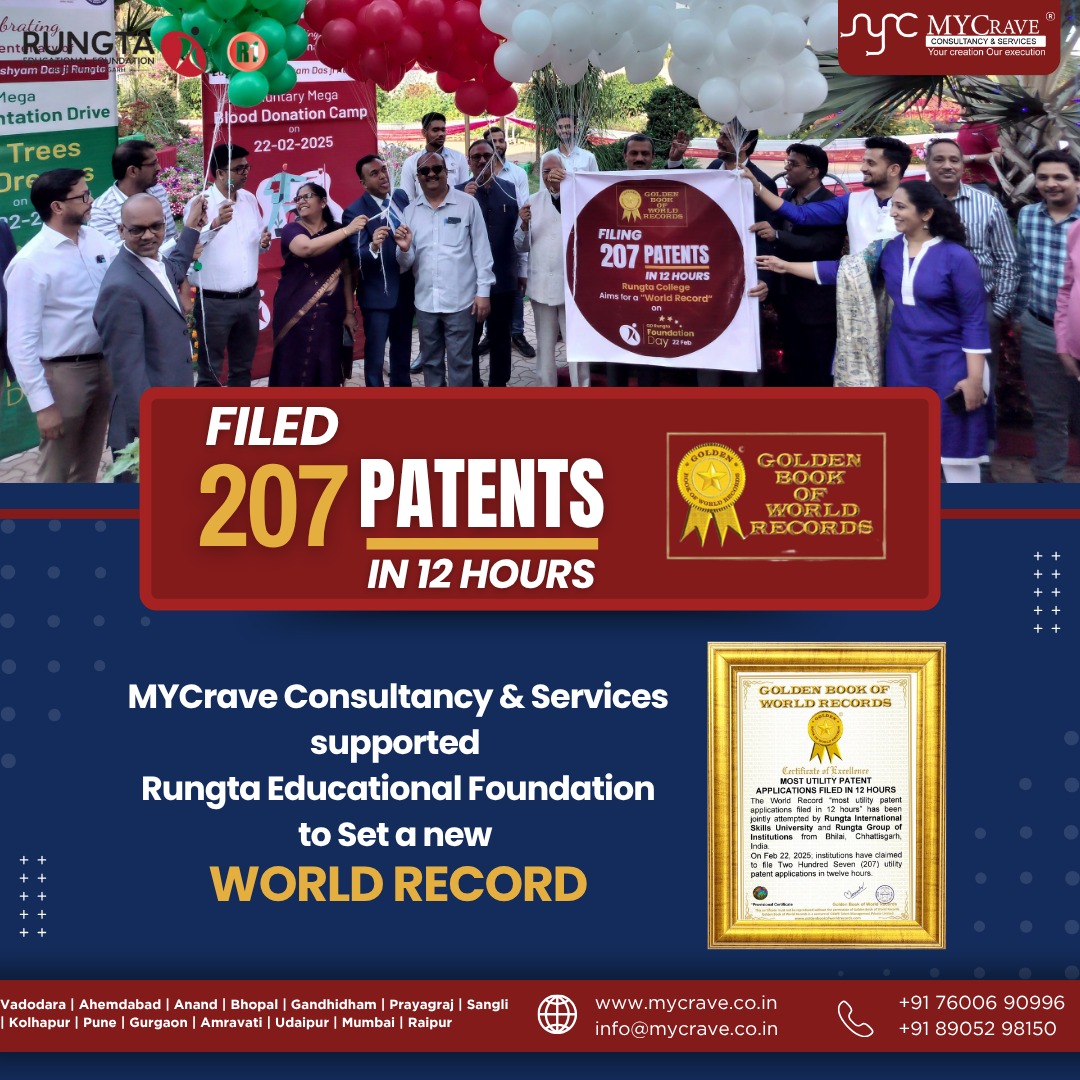
207 patents in 12 hours
The filings took a day. Getting an institution to the point where 207 applications were ready to file took a year — and that is the part worth studying.
Background
MYCrave has worked with Rungta Education Foundation since 2016 — nearly a decade of seminars, workshops, faculty sessions and individual mentoring across the group's institutions in Bhilai, Chhattisgarh. That long relationship matters. Bulk filing exercises fail when attempted cold; they succeed when the underlying culture already produces disclosures.
By 2024 the institution had reached a point where innovation activity was steady but the protection pipeline lagged behind it. Student projects and faculty research were generating protectable output faster than it was being formally captured. The Foundation Day on 22 February became the focal point for closing that gap in a single, visible push.
The challenge
Filing 207 utility patent applications inside one 12-hour window is not primarily a speed problem. It is a readiness problem, and it breaks in four places.
Disclosure quality: an application can only be drafted from a disclosure that actually explains the invention. Vague submissions stall everything downstream.
Novelty risk at volume: each invention needs its own prior-art position. Filing in bulk without searching in bulk creates a portfolio of weak applications.
Documentation load: specifications, claims, drawings, inventor declarations and forms — multiplied by 207.
Inventor availability: signatures and declarations from several hundred student and faculty inventors, coordinated to a single deadline.
The obvious failure mode is a rush that produces 207 filings and very few grants. Avoiding that was the actual brief.
How MYCrave approached it
The work was front-loaded across roughly a year, structured so that the filing day was an administrative event rather than a technical one.
Awareness at scale: over 5,000 students and 250 faculty members were taken through what patents are, what qualifies, and why publishing or presenting before filing destroys novelty. More than 70 seminars and webinars were delivered across the group.
Converting awareness into disclosures: two dedicated IP clinics gave innovators hands-on guidance on turning a project into a disclosure a drafter can work from. This is the stage most institutional programmes skip, and it is why most produce enthusiasm without filings.
One-to-one mentoring: more than 125 individual expert sessions were run with inventors closest to filing readiness — resolving scope, identifying what was genuinely novel, and separating the inventions worth protecting from those that were not.
Drafting discipline: the documentation effort of 6,680 pages across the 207 applications was led by Pooja Menon, Chief Operating Officer at MYCrave and a registered Patent Agent. Having a registered agent own the drafting standard is what separates a bulk filing from a bulk submission.
The result
On 22 February 2025, 207 utility patent applications were filed within a 12-hour window. The attempt was made jointly by Rungta International Skills University and Rungta Group of Institutions, Bhilai, and recognised by the Golden Book of World Records for the most utility patent applications filed in 12 hours.
The number that matters more is the one behind it: an institution that now has several hundred people who understand what protectable work looks like, a functioning disclosure process, and a filing pipeline that did not exist a decade ago.
Why this matters beyond the record
It demonstrates institutional capability rather than a stunt. The filings were possible because awareness, disclosure and mentoring infrastructure already existed.
It gives other institutions a replicable model. The sequence — awareness, clinics, mentoring, filing — is the same one MYCrave uses across its IPR Cells, at whatever scale an institution can sustain.
It converts accreditation pressure into real output. NAAC, NBA and NIRF frameworks reward innovation evidence, and this produces that evidence as a by-product of doing the work properly.
It creates commercialization raw material. Filed applications are the input to licensing and technology transfer — the stage most institutional IP never reaches.
An honest note on what a record means
A filing is not a grant. Every one of these 207 applications now enters the ordinary Indian patent process — publication, request for examination, examination reports, and in many cases hearings. Some will be granted, some narrowed, and some will not survive examination. That is true of any patent portfolio anywhere.
What the record demonstrates is capacity and preparation, not guaranteed outcomes. We say this plainly because an institution considering a similar programme deserves to plan against reality rather than a headline.
Protecting something similar?
Talk to an IP expert