That publishing kills patentability
The single most common loss. A paper or a project exhibition goes out first, and the invention can no longer be patented.

We have delivered 4,200+ seminars to more than 2,00,000 participants across 21 states. Book one for your institution — online or on campus — and your students leave knowing what they can protect and how.
Tell us what you have built. We will tell you honestly what it needs — and what it costs.
The single most common loss. A paper or a project exhibition goes out first, and the invention can no longer be patented.
Everything gets called a patent. Most student work is actually registrable as a design, a copyright, or both, at a fraction of the cost.
Students assume IP is for corporations. Government fees for a natural person are a small fraction of the corporate rate.
IP protects an implementation, not a thought. Knowing where that line sits changes how students document their work.
Patent, design, trademark and copyright — what each protects, with examples students recognise.
Section 3 exclusions explained practically, using real applications rather than statute text.
Why publishing, exhibiting or demonstrating before filing destroys novelty, and how to sequence it safely.
The actual route from disclosure to grant, with current government fees for individuals, startups and institutions.
Including a student-built application transferred for Rs. 42 lakh, and 106 designs released for public use.
Students and faculty bring their own projects. This is usually the most valuable part of the session.
Department, year, approximate numbers, and whether faculty are attending. The content is adjusted accordingly.
Online sessions can be arranged quickly. On-campus visits are scheduled around our regional teams.
Sessions typically run 60 to 90 minutes including questions. Longer workshop formats are available.
Presented by our IP consultants, with practical examples relevant to your departments.
Where a project looks protectable, we offer a free assessment. There is no obligation on the institution or the student.
Real work from our filings across manufacturing, education, pharma and consumer products. Client names appear only where we have permission to use them.
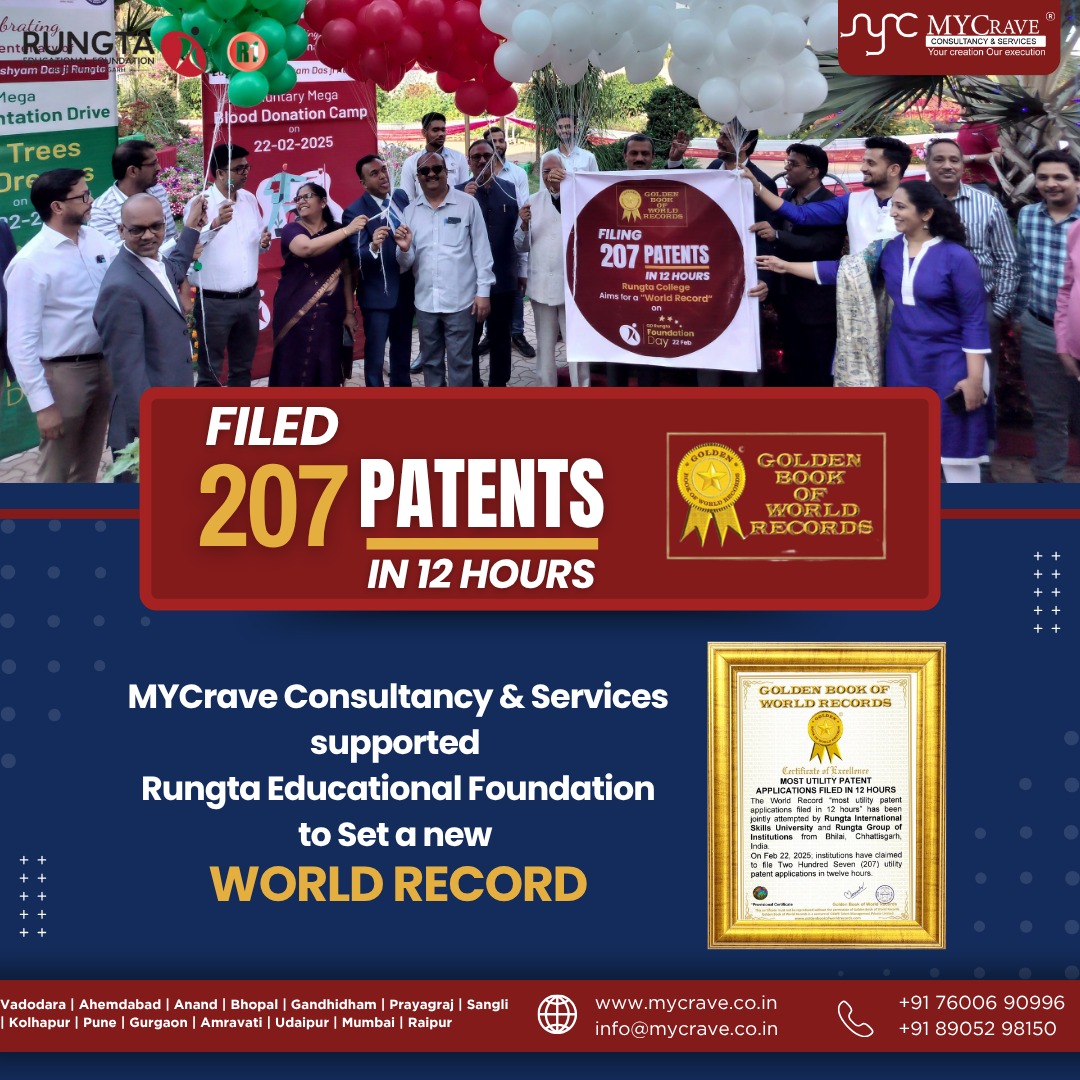
Rungta Education Foundation, Bhilai, Chhattisgarh
207 patents in 12 hours
MYCrave supported Rungta Education Foundation to file 207 utility patent applications in a single 12-hour window — a Golden Book of World Records achievement built on a year of preparing 5,000+ students and 250+ faculty.
Mr Satyam Mishra, Sigma University
Rs. 42 lakh copyright deal
An Android application in the customer feedback space was transferred to a private enterprise in a copyright deal valued at Rs. 42 lakh.
Mr Mithilesh Patel
106 designs released free of cost
An IP BANK India client made 106 industrial design patents available for public use, free of cost.
Yes. The session costs your institution nothing. We run these because a meaningful share of India's innovation never gets protected simply because nobody explained how.
There is not one. If a student or faculty member later wants to file, we would like to be considered — but there is no obligation, and the session is not a sales presentation.
There is no upper limit for online sessions. For on-campus sessions we work with whatever hall capacity you have; we have run sessions from thirty people to several hundred.
All of them. Engineering, pharmacy, design, management, agriculture, arts and science all generate protectable output, and we adjust the examples to the audience.
Online sessions can often be arranged within a couple of weeks. On-campus visits depend on our regional teams' schedules, so more notice helps.
Yes. Many institutions start with a seminar and go on to establish a cell. We have set up 70+ of them.
Not happy with something? We keep a dedicated complaint-handling team, separate from the people delivering your matter. Every complaint gets a reference number and an independent review. Raise a complaint or send feedback.
A short conversation is usually enough to tell you whether you have something protectable, which route fits, and what it will cost.